Case study: Marketplace platform
In a Pickle: From Startup Idea to Breakdown Marketplace
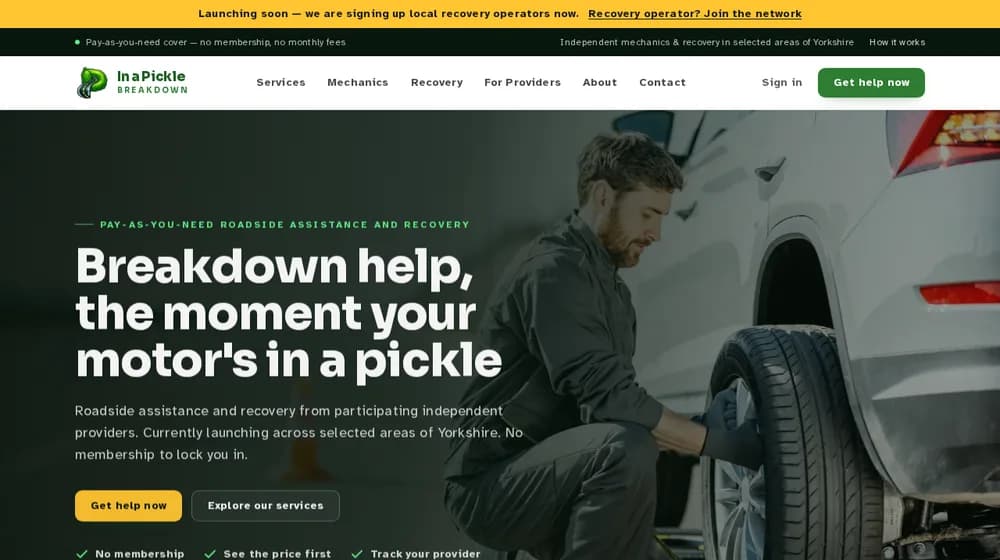
In a Pickle Breakdown set out to offer pay-as-you-need breakdown help: no membership, the price shown up front, and a vetted local operator you can watch arrive. There was no existing system to adapt, so everything had to be built from scratch.
At a glance
- Client
- In a Pickle Breakdown Ltd, a UK startup
- Status
- Signing up local operators ahead of launch (November 2026)
- The idea
- Breakdown help you pay for only when you need it, with the price shown up front
- What we built
- A three-sided marketplace connecting stranded motorists with vetted local recovery operators
- What we did
- Consultancy, product design, development, hosting and ongoing support
A marketplace runs on trust
A marketplace has to make strangers trust each other at a stressful moment, and protect each of them from the other.
- Motorists. need to know who is coming, when they will arrive and what it will cost, and that they won't pay for help that never turned up.
- Suppliers. need to know a job is real, that the customer will be there, and that they will be paid for work they have done.
- The business. needs every supplier properly insured and qualified, and a clear record of what was agreed when something goes wrong.
From an idea to an operating model
An idea becomes a business when every awkward situation has an answer. Much of this project was working through those situations with the founder, then turning each answer into a rule the software applies every time.
- When exactly is the customer's card charged, and for how much?
- What if the driver isn't sure whether the car can be fixed at the roadside?
- What if the operator arrives and nobody is there?
- How does anyone know the operator really arrived?
- What happens when a supplier's insurance runs out?
What we built
- Clear prices, even when nobody is sure. Customers see a fixed price before they commit. If they don't know whether the car can be fixed on the spot, they can choose "unsure", and if a roadside fix is enough, they pay the roadside price.
- Matching the nearest suitable driver. Each job goes to the closest driver who is approved and equipped for that fault, rather than whoever is listed first.
- Live tracking and verified arrival. The customer watches help arrive on a live map. Because the platform can tell when the operator really got there, it can settle arguments about who was where.
- Payments held, not taken. The customer's card is held for the price, and only charged when the job is settled. Operators know the money is there before they set off.
- Supplier vetting that stays current. Suppliers upload the documents their kind of work requires. When a document expires, they are warned beforehand and taken offline automatically.
- Automatic payouts. Each supplier's share is paid to their own account through Stripe, without anyone at In a Pickle handling their money.
- Fair answers when things go wrong. Cancellations, no-shows, unfinished jobs and disputes all have defined outcomes, instead of a phone call and an argument.
- A business the founder can run. More than 60 settings, from prices to dispatch radius, can be changed in the admin and take effect the moment they're saved.
Could this work for your business?
Take away the tow trucks and this is a pattern many service businesses share: a customer needs help, a vetted professional nearby provides it, and the platform protects both sides. The same approach suits emergency trades, mobile mechanics, cleaning and property services, couriers, and visiting professionals such as tutors.
Need a website that does more?
Tell us about your project, and we'll give you a free, no-obligation quote.
See our web design serviceMore case studies